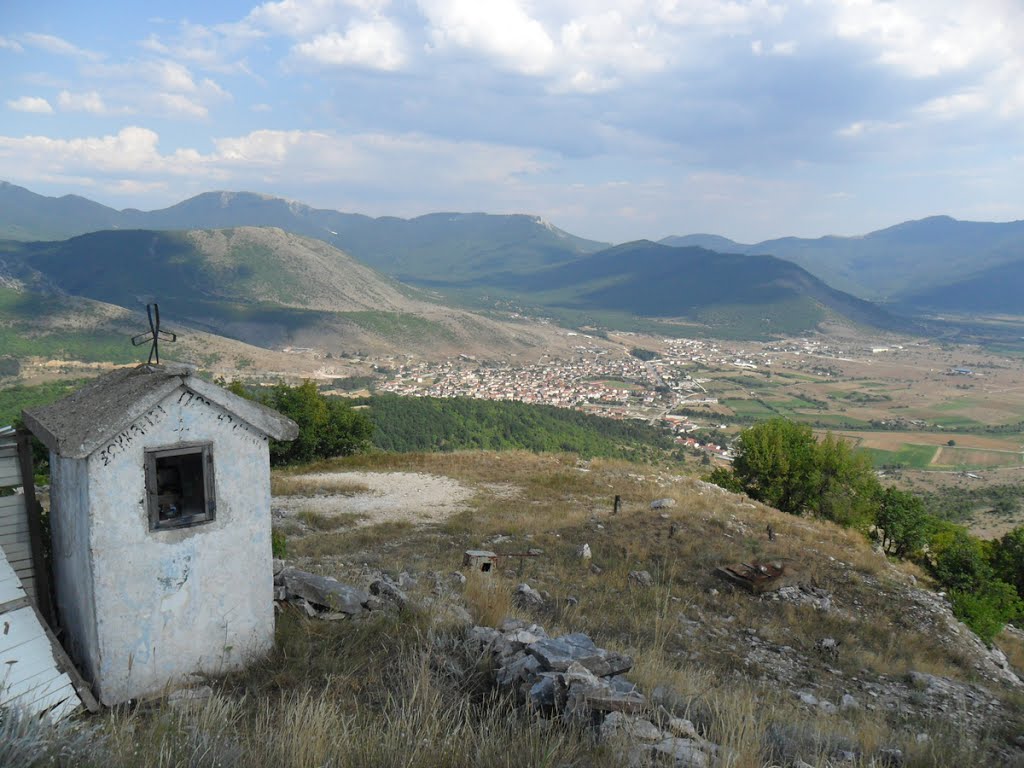
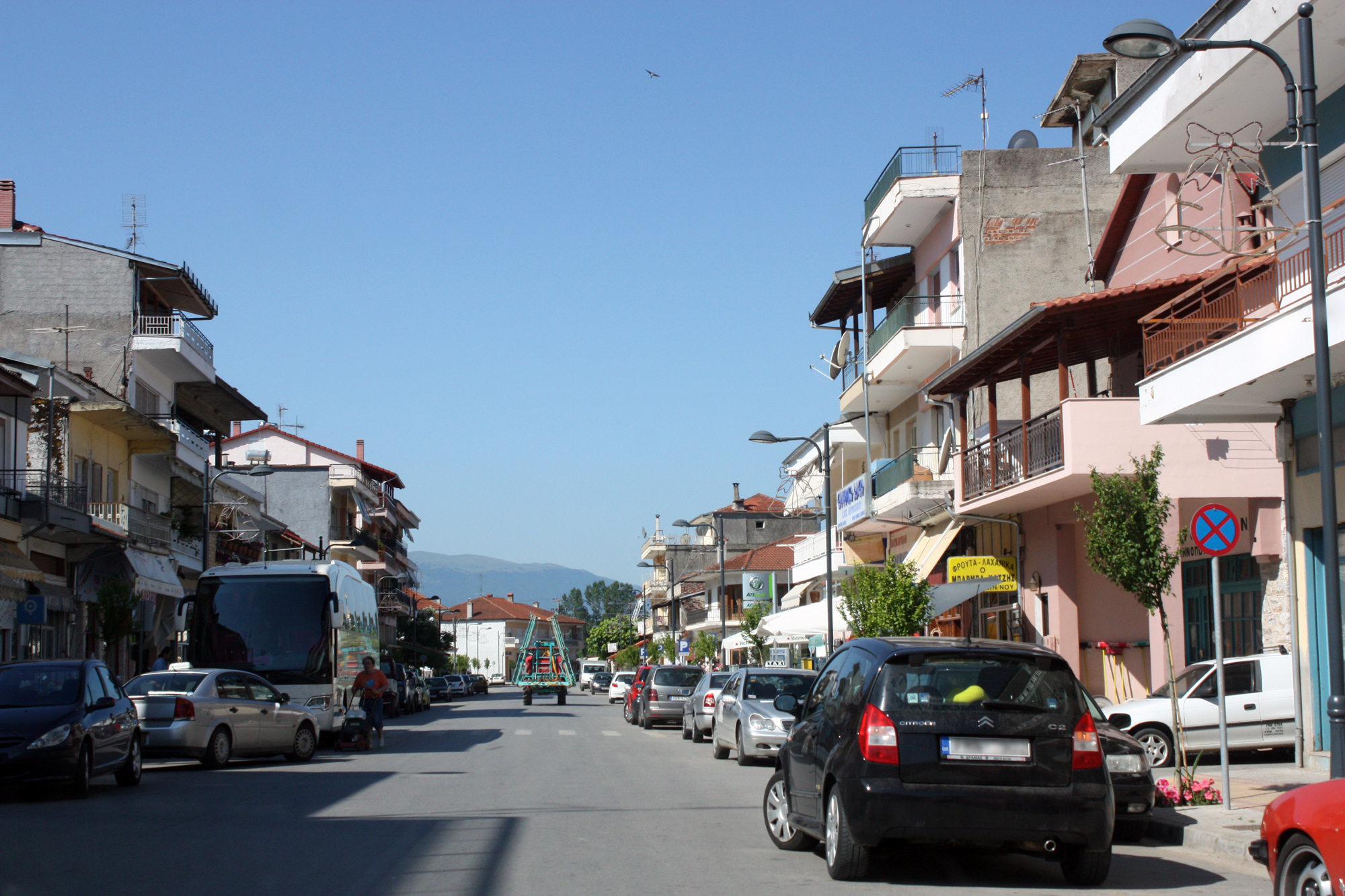
Kato Nevrokopi is a small town in Macedonia and the seat of the Municipality of Kato Nevrokopi. It had a population of 2,157 residents in 2011 and 1,855 in 2021. Administratively, it belongs to the Regional Unit of Drama in the Region of Eastern Macedonia and Thrace. Kato Nevrokopi is located at the center of the plateau of the same name, northwest of Drama, at a distance of 47 km from its center. It lies 12 km from the Bulgarian border, where the Exochi border crossing is located. The old name of the town was Zyrnovo, and it was renamed Kato Nevrokopi by Greeks from Ano Nevrokopi (now in Bulgaria) who settled there after the Treaty of Neuilly.
History
The wider area of Kato Nevrokopi has been inhabited since the Paleolithic period. During the Archaic period, its inhabitants had contacts with the central Balkans as well as the coasts of Macedonia and Thrace. The tribes that lived there were Thracian, mainly the Odomantes and Edoni. The basin area of Kato Nevrokopi was conquered by Philip II. After the Battle of Philippi in 42 BC, Romans settled in the area. During the Byzantine period, there were large estates, both private and monastic. After the 7th century, the area received waves of Slavic incursions from the north.
In 1383 the area was conquered by the Ottomans and Muslim populations were settled there. In 1530 it had 385 Christian and 219 Muslim households.
In 1870 the Bulgarian Exarchate was founded and a long period of national rivalries took place in Kato Nevrokopi as well. In 1882, the Greek side began efforts to resist Bulgarian claims with the help of the Greek Orthodox Metropolis. The Exarchists of Kato Nevrokopi claimed the church of Saint Demetrios. In 1899, Exarchist unrest over control of the church led the Ottoman administration to suspend its operation. At Easter 1901, the Ottoman administration allowed the church to reopen with alternating Greek and Bulgarian services, but at Easter 1902, due to continued incidents, it was closed again. The following year, Bulgarian komitadjis took armed action in the area in order to intimidate the Greek population. During this time, the teacher Thomas Papageorgiou was murdered. At the height of the Macedonian Struggle, in October 1903, through the initiative of the Metropolitan of Drama, the church of Saint Demetrios reopened for the feast of the saint with participation of both Patriarchists and Exarchists. However, on Saint Demetrios’ day, an armed group of 30 komitadjis attacked the church and arrested the Greek church trustees Ioannis Zafeiriou, Nikolaos Germanos, his son Georgios Germanos, and the teacher Konstantinos Christidis, whom they executed. On Christmas Eve 1906, a force of 300 komitadjis surrounded Kato Nevrokopi and after a three-hour attack murdered Greek notables.
The Greek Army liberated the town on July 4, 1913. In the following years, and after population exchanges, refugees from Asia Minor, Pontus, and Eastern Thrace settled in Kato Nevrokopi. The Muslim inhabitants migrated to Turkey according to the Greco-Turkish population exchange, while until 1932, 324 Exarchist families migrated to Bulgaria.
On April 1, 1927 the town was renamed from Zyrnovo to Kato Nevrokopi.
Notable People
From the area of the present Municipality of Nevrokopi originated many prominent 19th-century icon painters, such as Stergios Georgiadis and Georgios Zyrnovitis (from Kato Nevrokopi) and Dimitriou (from Kato Kafito), who painted the churches of the region: in the town of Kato Nevrokopi and in the villages Dasoto, Kato Vrontou, Perithori, Lefkogeia, Pagoneri, Volakas, Akrino, Livadaki, Ochyro, Exochi, Vathyto, and Granitis, during the period 1812–1890.[5]
The inhabitants of the area actively participated in the struggles for Macedonia during the Macedonian Struggle period. The most important Macedonian fighters were Ioannis Avrionis from Perithori, Dimitrios Pentsas from Pagoneri, and Armen Kouptsios from Volakas[6]. Another notable figure was Christos Taskas from Pagoneri, who acted as a leader of resistance groups during the Occupation[7]. Bishop of Rogoi Filotheos Theodoropoulos was born in Kato Nevrokopi and serves as auxiliary bishop of the Archbishop of Athens.[8]
Climate
Kato Nevrokopi is located 42 km from Drama and has a continental climate with cool summers and characteristically cold winters.